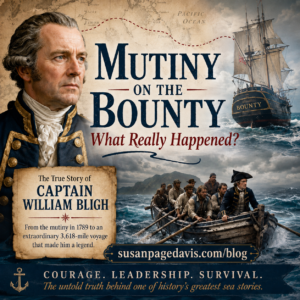
Let’s talk about Captain William Bligh.
Here’s what you probably know about him:
- He was captain of the HMS Bounty when the famous mutiny occurred.
- ?
What you probably don’t know about him:
- He rose in the British Royal Navy to the rank of vice admiral.
- He was fourth governor of New South Wales, Australia.
- He was signed up for the Royal Navy at age seven. At that time (1761), it was common to sign on “young gentlemen” so they could gain experience at sea.
- Captain James Cook chose Bligh as master of one of the ships in his fleet when he made his third voyage to the Pacific. It was during this voyage, ten years before the famous mutiny, that Cook was killed by natives in Hawaii.
- Between wars (1783-87), Bligh was a captain in merchant service. This was when he met Fletcher Christian, a young sailor he befriended and mentored, teaching him navigation.
- After the mutiny led by Christian in April, 1789, Bligh and his loyal men were set adrift in 23-foot open boat. Under Bligh’s guidance, they sailed 3,618 nautical miles (equal to 6,701 km or 4,164 land miles) without charts to the nearest European settlement at that time, in Timor. They lost only one man, a quartermaster killed by natives when they attempted to stop at an island for supplies.
Because of that feat, Bligh is still known today as one of the best navigators ever. He honed his skills while serving under Captain Cook. The voyage to Timor in the small boat seemed impossible, yet in 47 days, he and his men arrived there.
How did he do it? When Christian and his cohorts put them adrift, they let Bligh and his men have four cutlasses, a quadrant, a compass, and enough food and fresh water for about a week. Everyone assumed they could make it to an island called Tofua, not far away, and resupply there. But that’s where the hostile natives attacked them and killed the quartermaster, so they didn’t get the food and water they needed.
From May 4 to 29, the eighteen men in the boat lived on about an ounce and a third of bread each per day. The boat was so full of men, it sat low in the water. Because it was so crowded, four loyal men had been left behind with the mutineers, who later released them in Tahiti. But those in the launch suffered badly. They sailed through stormy seas, in constant fear of sinking, and nearly starved.
On May 29, they sighted an island of the Great Barrier Reef, near Australia. This area was not yet colonized. Bligh sketched maps as they sailed along the reef, through what is known as the Torres Strait, between Australia and New Guinea, and on toward the Indian Ocean. They landed at Timor on June 15. Some of the men died of illness soon afterward, but most of the survivors went on to Batavia (modern day Jakarta) and waited for a ship to take them to England.
The cause of the mutiny has never been satisfactorily explained. Though Bligh has been portrayed in fiction and films as an intolerant, even sadistic man, the records say otherwise. While he didn’t suffer fools gladly, he was known as rather an “enlightened” captain, who was concerned about cleanliness, good diet, and exercise to keep his crew healthy. He was not mean, and indeed was slower to punish his crewmen, and with milder sentences, than some other officers of the time.
Much more could be told about Bligh’s life, his later accomplishments, and about the mutiny and its aftermath, but we will leave that for another day.
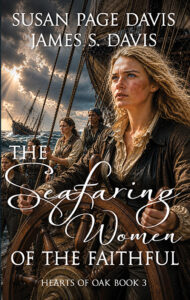
Join the seafaring fun! Pre-order the new book Seafaring Women of the Faithful here.
If you haven’t read the first two books in the Hearts of Oak series, you’ll enjoy The Seafaring Women of the Vera B and The Scottish Lass. These historical adventures are co-authored with my son, James S. Davis. Since we’re speaking of mutinies today, you can find one in The Scottish Lass, Book 2.
Visit my website at: https://susanpagedavis.com . Sign up on the home page for my monthly free book drawing. You can request one of the Frasier Island series, a modern romantic suspense series with a naval setting: Frasier Island, Finding Marie, and Inside Story. Or you can pick one of my other contemporary or historical books from an extensive list. The drawing is held at the end of each month.
Susan Page Davis is the author of more than one hundred published novels. She’s always interested in the unusual happenings of the past. She’s a two-time winner of the Inspirational Readers’ Choice Award, and also a winner of the Carol Award, three Will Rogers Medallions, and was a finalist in the WILLA Awards and the More Than Magic Contest. She now lives in western Kentucky.