My son Jim and I did a ton of research on Australian history while writing the first book in our Hearts of Oak series. One fascinating person we learned about was Mary Bryant. Here’s a short account of what Mary faced when she was shipped to Australia as punishment for theft.
In 1830, there were 7 men for every woman in Victoria, Australia. Both free settlers and female convicts were sent to Port Phillip, where the city of Melbourne grew up. The labor shortage was so severe that many single women sailed out with other families, to work as domestic servants. The life was hard, and servants who lost their jobs or became pregnant found themselves on the street.
For female convicts, a sentence of transportation, or being shipped to England’s colonies in Australia, often meant unwilling prostitution. The conditions were so unbearable that some women chose execution over transportation.
Mary (Broad) Bryant was one young woman who became renowned for her dramatic escape from the colony. She was born in 1765 in Cornwall, England, to a fishing family also known for sheep stealing.
Mary went to the town of Plymouth to look for work, got in with the wrong people, and began a career of theft. At the age of 21, she and two other women were caught. Her crimes were highway robbery and assault, and she was convicted of stealing a silk bonnet, jewelry, and a small amount of money. She was sentenced to death. This sentence was commuted to transportation for seven years.
In May, 1787, she was removed from the jail at Exeter and placed on the ship Charlotte, which was part of what is known as the First Fleet. They sailed for Botany Bay.
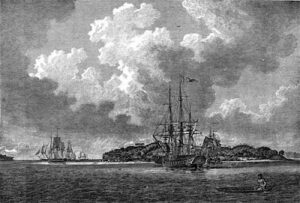
Engraving of the view of Botany Bay at Gov. Phillip’s arrival in 1789. Public domain.
The First Fleet consisted of 11 ships traveling from Great Britain to Australia to found a penal colony, which became the first European settlement in Australia. The fleet included two Royal Navy ships, three ships of stores, and six convict transports, including the Charlotte.
More than 1,000 convicts, marines, and seamen were aboard the fleet. The Charlotte carried 100 male convicts and 24 females. The voyage to Australia’s Botany Bay took 252 days, and they arrived in January, 1788.
The women aboard were at the mercy of the sailors and other men. Mary was probably already pregnant when she boarded, and she gave birth to a little girl in Cape Town, a stop on the way to Australia. Historians speculate that the father may have been an English prison guard.
The land at Botany Bay was found unsuitable for the colony. There was no fresh water supply, so the governor moved the location of the settlement north to Port Jackson, also known today as Sydney Harbor.
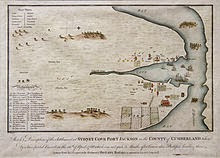
Early map of Port Jackson
A month after arriving, Mary was married to a fellow prisoner named William Bryant, age 31, also from Cornwall. William was a fisherman convicted of resisting revenue officers—he was probably caught smuggling. He was sentenced to seven years’ transport to America, but his destination was changed to Australia, and he ended up on the Charlotte with Mary Broad. William and Mary Bryant were among the first couples married in the new colony.
The couple lived in a hut with the baby girl, Charlotte. William was in charge of the fishing boats and planted a garden. About a year later, he was caught selling some of his catch illegally and received 100 lashes.
A food shortage made the colonists desperate. William was no longer in charge of the fishing boats. Life was very hard for them. Mary had another child in April, 1790, a boy they named Emanuel. People were starving in Port Jackson. They decided to try to escape the colony in order to save their children’s lives.
When a Dutch ship arrived, sources say William obtained a compass, charts, a quadrant, two muskets, ammunition, and some food from the Dutch captain.
In March, 1791, William and Mary and seven other convicts made their escape. They had waited until a night with no moon, when no ships that could pursue them were in the harbor. With the two children, eleven people boarded the governor’s cutter, which had masts, sails, and six oars.
Their voyage of 69 days has become known as one of the most daring feats of sailing ever. It has been compared to Captain William Bligh’s voyage two years earlier in an open boat after the mutiny on the Bounty. The party is credited with making several discoveries, including some of the previously uncharted islands along the Great Barrier Reef.
They reached the island of Timor after a journey of more than 3,254 miles (more than 5,000 km). Timor was under Dutch control at the time. The escapees claimed they were survivors of a shipwreck. It was later discovered that they were escaped British convicts, and they were sent back to England for trial.
During the trip back, William Bryant and both of Mary’s children died of fever. Little Charlotte’s death came just five weeks before they landed in England. Mary’s purpose for undertaking the dangerous escape was defeated, and she was now alone. She and four of the male prisoners survived, arriving in England June 18, 1792. James Boswell championed their case and appealed for clemency.
Usually the punishment for escaping from transportation was death, but this time the prisoners were allowed to serve out the remainder of their original sentences. Mary’s sentence expired about a year later, and she was released from Newgate prison May 2, 1793. She returned to her family in Cornwall. James Boswell sent her a small stipend until his death two years later.
Mary’s story has been fictionalized in several books and plays, and a British/Australian television movie entitled The Incredible Journey of Mary Bryant. On display in the Mitchell Library in New South Wales are two Botany Bay tea leaves that came from a packet Mary sent to Boswell in thanks.
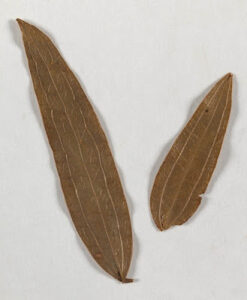
Courtesy State Library of New South Wales, from the James Boswell collection relating to convict Mary Bryant.
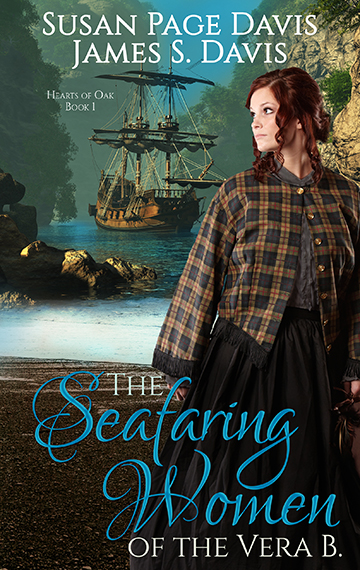
My son Jim and I are the co-authors of the Hearts of Oak series, about women who needed to escape Australia in the 1800s and join the crew of a sailing brig. Alice Packard’s husband had been its captain, but he died in Melbourne. Alice decided to sail the ship back to England with a crew of women. Read about their adventures in the first book, The Seafaring Women of the the Vera B. Book 2, The Scottish Lass, is also available, and the third installment, Faithful Seafarers, will release in September, 2026.
Susan Page Davis is the author of more than 110 published novels and novellas. A history major, she’s always interested in the unusual happenings of the past. She’s a two-time winner of the Inspirational Readers’ Choice Award, and also a winner of the Carol Award and three Will Rogers Medallions, and a finalist in the WILLA Awards and the More Than Magic Contest. Visit her website and see all of her books at: https://susanpagedavis.com. Her son Jim’s author page is at: https://jsdauthor.com/